
End-month 2026 news January
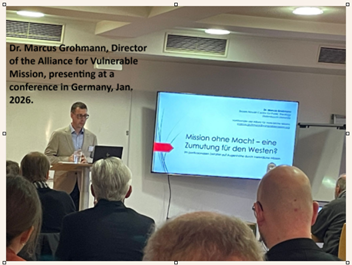
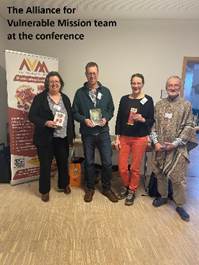
Conference in Germany
Below are pictures of some of my colleagues in the AVM (Alliance for Vulnerable Mission) at a missions’ conference in Germany. (I was not there!)
An Article by Jim Harries that has just gone to press:
I wrote this article following a flash of inspiration. I believe it very simply and clearly explains how the Gospel of Jesus exposes, and then by faith replaces, witchdoctors’ wisdom of a bygone era. My thesis is that, without the Gospel, people could not even recognize witchdoctors in the first place. Their role was simply very normal and universally hegemonic. It has been displaced in much of the world: Harries, Jim, 2026, ‘The Witchdoctor’s Craft,’ Global Missiology-ISSN 2831-4751 -Vol 23, No 1 (2026) January, 54-64. http://ojs.globalmissiology.org/index.php/english/article/view/3044/7631
MUM
Mum is in a hospital in Portsmouth. She needed treatment for a lung infection. We hope a nursing home will again soon be found for her. Your prayers for her valued.
Are you Optimistic?
A friend recently asked me “are you optimistic about your missions endeavours?” One thing that reading the Bible is telling me, is that God always takes the glory for things he does. I am currently reading through Exodus, which is a good example of that. Moses’ and Aaron’s incompetence is compensated for my God’s displays of power. So is the nature of mission work. Failure can be achievement. Faithfulness is more important than ‘success’.
At the same time, yes I am optimistic. I am often enthralled by the sheer privilege of having such a key role to play in this community. My work offers me many opportunities for evangelism and discipleship. All that without either great expense, much administration or many complicated meetings. People often stop me and say ‘please come and share at our church / fellowship.’ Ironically, many tell me how much they appreciated a message that I shared many years ago, when I myself have typically forgotten anything that I said at the time. My prayers are simply that the Lord provide me with the insights that he wants me to share.
Our living here in the church compound is also encouraging. One neighbour recently commented that we are living ‘as one big family’. She is right. Fellowshipping around the Word every evening, our neighbours included, I find is a good way to end the day. (We do not have a TV.)
Globally there is a massive work to be done. I am pleased by recent progress of the AVM (Alliance for Vulnerable Mission) in addressing extant challenges. I am optimistic that if we work hard enough, by God’s grace, things can change!
Interference in Sense-making
A massive ‘elephant in the room’ constantly trips up activities people engage in Kenya and much of Africa. This ‘elephant’ is mandated by African governments themselves.
Some years ago now, at a youth conference of my local church, I mentioned one or two problems of use of English in Kenya to the assembled young people. A few hours later the bishop called me aside. ‘Never speak critically of the use of English in Kenya Jim’, he told me.
Indeed, everywhere around here, English is a sacred cow. Achieving knowledge of English is the primary objective underlying Kenya’s educational system. (This should be slightly less the case now, as the Kenyan educational system is being reformed.) English is the life-line that connects people to more wealthy parts of the world. All formal government activities are in English. By law, all government and all private educational institutions, function using English.
Yet, use of English constantly adds to ignorance. People talk of things that they don’t understand. Use of English renders things that people do understand incomprehensible. Key issues for people are never addressed in formal circles. Possibilities for development and change are thwarted – the very use of English presupposes that needed changes have already happened. All Kenyan children are denied the ability to fulfil themselves, by being educated using English in a system that, one might say, occupies them fully from age about 4 to age 20 or more.
(Give thanks also that, although education is in English, its origins being in the church means that there is value in it.)
Give thanks for churches, who try to assist this relatively dire situation by taking up children on days they are free from school and in vacations.
I value your prayers in this. I have made many endeavours at throwing light into this area. Primarily, I do so by myself refusing to use English with African people. I have a lecture-proposal with the main national university (University of Nairobi) that addresses this issue. I become nervous even about the prospect of sharing it! Responses from the university itself are so-far themselves all in English. All my missionary colleagues predominantly use English in interacting with Kenyan people. For them, the prospect that they might relate to people in local tongues seems as likely as having a holiday on the moon.
The flip-side to use of English in Africa, is opposition to racism in the West. Instead of British people, for example, recognizing how culturally different people of African origin are from themselves, they are required to find themselves guilty of racism every time such a difference comes to the fore.
The insidious idolatrous penetration of English and other European languages into all corners of life bodes very badly for Kenya, and the rest of Africa. Resolving this dilemma is in some ways becoming more and more difficult as the days go by.
Advisory Missionary Role
People who know about such things, probably realise that Jim is likely to have slowed down a little, being almost 62 years old. This age brings an expectation of a change in role, into a more of an advisory role to other missionaries. I am glad to be able to say, that indeed this transition is happening. Please pray for the various young missionaries whose lives I am able to influence for them to be effective in serving God in Africa and beyond.
Many people in the West make out that there is no value whatsoever in the missionary role in the first place. The above domination of English is one source of this problem. The more Africans themselves use English, the more missionaries can seem to be unnecessary. This is not because the need for Western missionaries has gone, but because it is concealed from view.
I come back to asking for prayer for the (AVM) Alliance for Vulnerable Mission. Some will remember that I in the past made many trips to the USA/ UK / Germany seeking to reform mission, and offer advice to young would-be missionaries. Many of the missions’ courses, schools, and universities that I visited back then, have since either significantly shrunk or closed! We are today left with a dual role: revive the understanding of mission, and then, seek to provide guidance for missionaries who take up the challenge of sharing God’s Word across cultures. Pray for us in this.
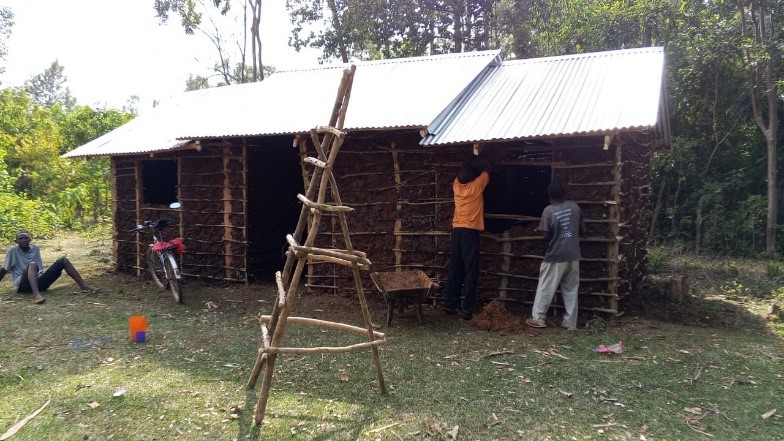
One of my one-time children, building his personal house in his home village, near my previous home.
Jim