
Mid-month news August 2026
Jimoharries@gmail.com
Dear Friends,
Mum
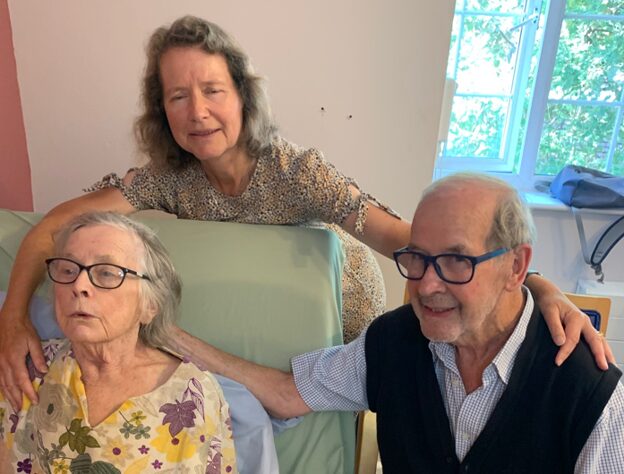
The major change in mum’s situation, is that we (as family) have a few times over the last few weeks, received ‘emergency’ warnings from the home she is in. Mum has a few times apparently rapidly deteriorated causing concern as to whether she was in her last days, then she has bounced back. We as family continue to give thanks for the good care she is receiving at the home she is in. Please pray for mum. (In the picture, my sister, mum, and dad.)
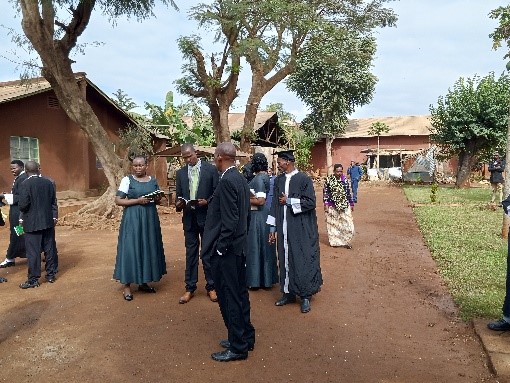
Graduation of Tanzanian Bible School
I attended this graduation event on 25th July. This was in Babati, Tanzania (not in Musoma, where these days I go more frequently). There were 12 graduates. Good news: the head of the church who was present, said the church was ready to absorb all graduates.
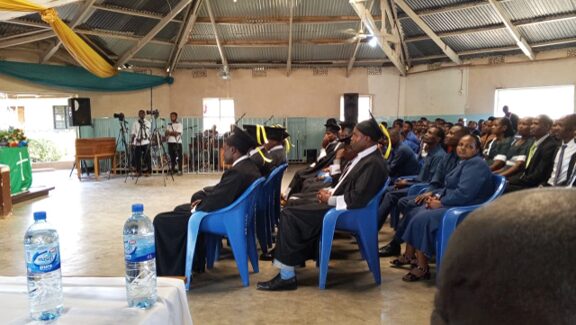
The programme began about 1 hour late, 10.30 instead of 9.30am. It over-ran by about 2 hours, finishing after 3pm instead of at the planned time of 13:00hrs. The guest of honour was our local MP, who was raised in the Church of God (Kanisa la Mungu) Tanzania. He offered TSh1,000,000 towards the communicated need for more books at the college. (That is around 300 UK pounds.) Following his prompting, another 1.6 million was raised, so that a total of around 800 pounds, more than had been asked for, is now available for purchase of new books by the college. Give thanks!
Back in Kenya
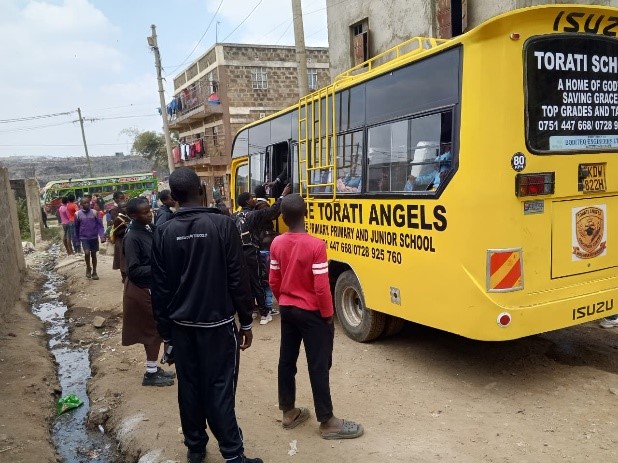
I arrived in Kenya on 27th July, then at home on 30th. For two days, I visited some of the children I once reared, now in their 20s and 30s. One of them took me to a ‘play-park’ for children just outside of Nairobi. Bus loads of children were brought for a rare opportunity to experience swimming, fairground rides, and just plain fun! I joined the crowd from the school at which he is now teaching at the fun-park.
Denominational Approval
Give thanks, and pray that I use wisely, a declaration made by a prominent local Bishop yesterday. Actually, this is not the first time he said it, but he repeatedly re-emphasised this yesterday. I joined a joint gathering of the church of this local bishop on 9th August. The church has many branches in the area, and it is one of the denominations I visit regularly. ‘Jim has good teaching’, said the Bishop. ‘Whenever Jim comes to one of our fellowships or denominations, he should be given opportunity to teach’, he said repeatedly. I know that he means it, am very grateful and honoured, and need to use these opportunities wisely
Church Visit
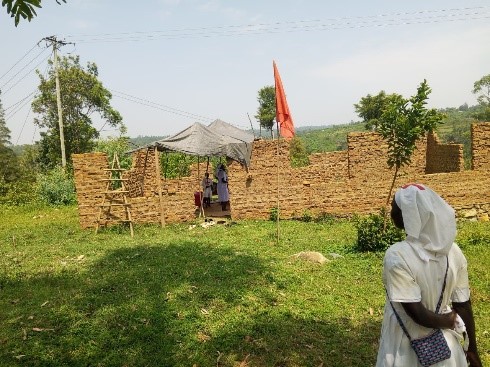
Below is the being-constructed church, on the top of a hill in a relatively cut-off place in this area, that I attended on Saturday. Give thanks for opportunities to share with people in such local congregations on a regular basis!
Tho Riwo
In the Luo language of Kenya, ‘tho riwo’ is to say in English, ‘death unites’. The death of a prominent (in the church) daughter of my home pastor has brough people back to my home church who had left many years ago. Give thanks for the unity we have in Christ, and pray for ongoing good relationships.
Days Ahead
Give thanks, that I have been able to re-engage ministry in my home area in Kenya. Pray for my teaching back in Tanzania for the last two weeks of this month. Pray for my writing of the article that I am currently working on. Pray for ongoing preparations for my teaching at Trellis International Training College come September.
Jason Arday
A number of you will have heard of the pressure put on Jason Arday that led to his resignation from the University of Cambridge. To those of us used to working in Africa and with Africans, his case illustrates frequent scenarios. To me, his case is not a one-off peculiar event, but an example of what is happening on a widespread basis. Plagiarism is certainly a massive issue in colleges and universities in Africa. Yet – students are being asked to do things, and assumed to be able to do things, which practically speaking given where students are coming from, are impossible. It would be really wonderful if African people even in the UK could be accepted in ways that they innately express themselves. If this were to happen, then African people could build on their self-understandings, instead of always having to pretend to be the same as Europeans. Yet … this being almost impossible even in Africa itself, seems unlikely in the UK.
Over-heard Preaching (a short essay)
(a short article, also posted here: https://www.academia.edu/attachments/133678377/download_file?s=portfolio )
By Jim Harries
A Christian denomination in Tanzania arranged a crusade (outdoor preaching) in the centre of a town. They deployed enormous speakers. Sitting in my room ½ km away, I could easily hear every word said. It was a Pentecostal church, so messages given were ‘Pentecostal’ messages. The sick and troubled were called forward. They were invited to have demons removed from them, to receive healing, release from curses, superstition (shirikina – the whole message was in Swahili) and other kinds of bondage. It seems that hundreds went forward. (What was said and what happened was very familiar. It was about 100% as would have happened in places more known to me in Kenya!)
When I listened carefully to what was being said, I found myself nodding. I was thinking: ‘yes, what was being said was helpful. It was likely to connect with local people, given their worldview and self-understanding.’ (That is not to say that I preach that way. It is too difficult for me to deal with what I would appear to be saying in translation into English if I was to do so. I am a native-speaker of English. East Africans do not have this problem. Their English is squeezed to fit into local contours.)
I realized, that this kind of spiritual-healing combined with prosperity Gospel message, is anathema in the ears of many of my fellow Westerners! Laws in European countries might imprison someone who does the kinds of things the preacher was saying. For example, someone’s child is sick. If a parent decides to prioritize prayer over secular medical treatment they could be criminally charged. Should a child die as a result of medical ‘neglect’, such a person could be considered guilty of manslaughter. Hence, in Tanzania, massive loudspeakers set up in a major town were broadcasting a Christian message which, in UK-terms, could have been encouraging illegal behavior! The above is not an isolated incidence. African wisdom may be illegal in the West.
Africans who seem to do things in a Western way, are loved by the West. This is like a victory for the West. Yet, massive contextual issues may be preventing African people from behaving in-totality as we might think someone Western-educated ought to behave.
Many in the West seem not to realise, should someone who is African born or raised by African parents become ‘truly Westernised’, that will be threatening to Africa! The implication is that Africanness is shallow, only skin deep, like fluff, not substantial, easily put aside. It implies that African ways of life are mere veneers, perhaps imaginary, superstitious, illogical and liable to disintegration when faced with Western secular truth.
African people often being evaluated according to how Western they are, is a cause of concern to me. In the case of the above preaching: a devoted, conscientious, intelligent person interpreting the Christian Gospel according to African context can, from a UK perspective, be accused of aiding and abetting criminality. There seems to be ‘something wrong with’ African people that usually stops them becoming professors in UK universities. … Then one has to realise: much of the anti-racism movement in the UK seems to be a denial of the substantial reality of African ways of living and ways of thinking! The West is wishing-something-away because they do not like it!
People, like the preacher above, interpreting in African ways, are not an extremist minority. They are part of the mainstream. Many have been plied with secular education for years and years of their lives. A good number have diplomas and degrees under their belts. Yet, getting a diploma does not cancel a worldview. It does not cancel one’s family. Formal educational curricula these days build on English. Because categories used in English in a deep sense are unfamiliar to Africa, Western education may make little inherent sense to Africans. Yet for an African to concede that it makes little sense, may be to commit economic-suicide.
In our days of rampantly multiplying possibilities of means of enforcing Western standards of globalization onto African people (AI is probably at the tip of this arrow of capability), we may be about to witness a catastrophe.
The West seems to think that Africa ‘should’ learn. Yet, if they think that what they are giving Africa to learn is simple and easily comprehensible and straightforward to appropriate, they are wrong. Partly what is happening in Africa, is a conscious decision not to learn. To actually take on board Western education as-it-is, given the foundations African people are living on, might require Africans to tear themselves apart on the inside.
Hence my appeal that the West, who holds many purse strings, build models of translation into their engagement with people in the majority world. Just to hear African and other people speak in English – is not good enough. Just to assume ‘they should be like us’, is not good enough! Just to think that we understand people because they use English, is not good enough. To simply ‘believe’ Africans when they speak to us using English, is not good enough.
The West must set up systems by which they can learn from ways in which indigenous people in Africa and elsewhere understand one another. This does not require subsidising African learning of English. It requires Westerners who comprehend African languages in use amongst Africans in familiar African environments. (Some people might say ‘but Africa is very diverse’. Well, yes it is, but not that diverse! The West likes to emphasize African diversity as a way of trying to conceal how weird the West is.)
I am not saying that the Tanzanian preachers I heard are necessarily ‘correct’. That is not the point. Only God though, ultimately, not the West, can judge what is ‘correct’ and what is not. Tanzanian preachers may be correct in some respects and not in others. Our issue goes beyond ‘correctness’. One concern ought to be: does what is communicated make sense to people? If it does not, then how can that be the ‘true Gospel’?
It sometimes seems that African versus Western worldviews are mutually incomprehensible. Because it has mostly been the West that is coming up with global systems, I believe the same West therefore has a responsibility to enable Africa to thrive. Not only to thrive now, but also to thrive in decades and centuries ahead. This requires putting systems in place that do not render Africans illegal as a result of their not being Western. Before this can even be begun, there must be a possibility of comprehension of what is ‘non-Western’, a comprehension of ‘what is dominant in Africa’; something these days barely if at all achieved.
Perhaps, in the end, the West is correct, and their way of life is the best and superior one. I do not deny this possibility. I appeal for flexible license in our globalized world to learn on the part of non-Western people who cannot yet grasp the foundations of what is alluring in Western civilisation. I appreciate that this is a difficult challenge for any secular-authority to take on.
Jim